Google
 
Showing posts with label Badminton Eye Training. Show all posts

09 April 2007

Melatih Mata


TANGGALKAN KACA MATA ANDA!!
Oleh: dr. Yuda Turana
Sumber: medikaholistik


Sudah lama dipercaya bahwa semakin usia tua fungsi penglihatan menurun dan proses itu sulit untuk dihindari. Para naturopath menganjurkan untuk diet yang baik dan latihan otot-otot mata untuk meningkatkan fungsi penglihatan.

William H Bates adalah dokter mata dan dosen di New York Postgraduated Medical School yang pada tahun 1919 menerbitkan buku : Better Eyesight Without Glasses yang berisi latihan-latihan untuk meningkatkan fungsi penglihatan . Dia berprinsip kaca mata adalah tidak mengobati penyebab dari menurunnya fungsi penglihatan . Dalam buku alternatif latihan tersebut sering disebut metode Bates. Berikut latihan yang dapat anda lakukan untuk meningkatkan fungsi penglihatan anda :

1. PALMING

Pejamkan mata anda dan tutup dengan kedua telapak tangan . Pastikan tidak menyentuh mata. Lalu pikirkan sesuatu yangmenyenangkan atau dengarkan musik. Jangan kosongkan pikiran anda karena dapat mengakibatkan mata anda tidak rileks

Lakukan 2 – 3 kali sehari masing-masing selama 10 menit.

2. SPLASHING

Siramlah mata anda yang terpejam dengan air hangat 20 kali kemudian 20 kali dengan air dingin. Ulangi hal ini sore hari namun lakukan dahulu dengan air dingin kemudian hangat.

3. NEAR AND FAR FOCUSING

Peganglah pensil di depan mata anda kurang lebih 15 cm dari hidung. Dan pensil yang lain sejajar namun dalam posisi yang lebih jauh, sejauh tangan anda dalam posisi lurus. Fokuskan penglihatan mata anda pada pensil yang satu kediplah kemudian fokuskan pada pensil yang lain. Perhatikan bahwa anda hanya fokus pada satu pensil secara bergantian namun anda tidak melihat double.

4. SWINGING

Berdiri didepan jendela dengan kaki agak sedikit berjauhan kemudian latihlah mata anda untuk melihat ke kanan dan ke kiri pada objek di luar jendela. Kediplah saat pindah gerakan dari tiap sisi. Perhatikan seolah-olah jendela berpindah pada arah berlawanan dari diri anda.

5. SHIFTING

Saat anda melihat suatu objek. Pusatkan perhatian anda pada objek tersebut. Kemudian lihatlah batas atas dan bawah objek. Kemudian batas kiri dan kanan objek. Kemudian Batas objek tersebut anda perkecil dan lihatlah batas objek atas bawah, kanan kiri. Semakin kecil batas objek maka semakin maka semakin terlatih otot mata anda.

Latihan dapat anda lakukan secara teratur 2-3 kali sehari.

( Catatan : Metode Bates ini hanya pada gangguan penglihatan akibat refraksi dan bukan karena katarak maupun glaukoma , konsultasikan dengan dokter anda )


Seputar Bulutangkis
bulutangkisindonesia.blogspot.com

Mengenal Mata

Indra mempunyai sel-sel reseptor khusus untuk mengenali perubahan lingkungan. Indra yang kita kenal ada lima, yaitu:

1. Indra penglihat (mata)
2. Indra pendengar (telinga)
3. Indra peraba (kulit)
4. Indra pengecap (lidah)
5. Indra pencium (hidung).

Kelima indra tersebut berfungsi untuk mengenali perubahan lingkungan luar, oleh karenanya disebut eksoreseptor.

Reseptor yang berfungsi untuk mengenali lingkungan dalam, misalnya nyeri, kadar oksigen atau karbon dioksida, kadar glukosa dan sebagainya, disebut interoreseptor.

Sel-sel interoreseptor misalnya terdapat pada sel otot, tendon, ligamentum, sendi, dinding saluran pencernaan, dinding pembuluh darah, dan lain sebagainya. Akan tetapi, sesungguhnya interoreseptor terdapat di seluruh tubuh manusia. Interoreseptor yang membantu koordinasi dalam sikap tubuh disebut kinestesis.

INDERA PENGLIHAT (MATA)

Mata mempunyai reseptor khusus untuk mengenali perubahan sinar dan warna. Sesungguhnya yang disebut mata bukanlah hanya bola mata, tetapi termasuk otot-otot penggerak bola mata, kotak mata (rongga tempat mata berada), kelopak, dan bulu mata.

1. Bola Mata

Bola mata mempunyai 3 lapis dinding yang mengelilingi rongga bola mata. Ketiga lapis dinding ini dari luar ke dalam adalah sebagai berikut.

a. Sklera

Sklera merupakan jaringan ikat dengan serat yang kuat; berwarna putih buram (tidak tembus cahaya), kecuali di bagian depan bersifat transparan, disebut kornea. Konjungtiva adalah lapisan transparan yang melapisi kornea dan kelopak mata. Lapisan ini berfungsi melindungi bola mata dari gangguan.

b. Koroid

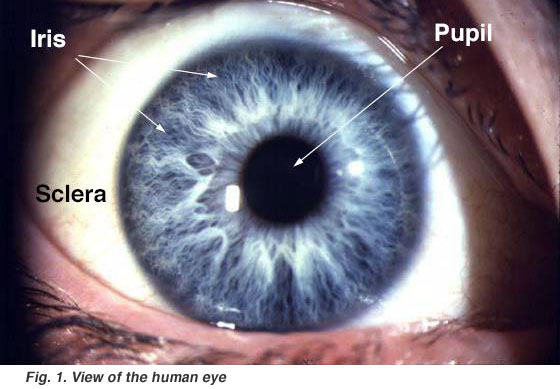
Koroid berwarna coklat kehitaman sampai hitam; merupakan lapisan yang berisi banyak pembuluh darah yang memberi nutrisi dan oksigen terutama untuk retina. Warna gelap pada koroid berfungsi untuk mencegah refleksi (pemantulan sinar). Di bagian depan, koroid membentuk badan siliaris yang berlanjut ke depan membentuk iris yang berwarna. Di bagian depan iris bercelah membentuk pupil (anak mata). Melalui pupil sinar masuk. Iris berfungsi sebagai diafragma, yaitu pengontrol ukuran pupil untuk mengatur sinar yang masuk. Badan siliaris membentuk ligamentum yang berfungsi mengikat lensa mata. Kontraksi dan relaksasi dari otot badan siliaris akan mengatur cembung pipihnya lensa.

c. Retina

Lapisan ini peka terhadap sinar. Pada seluruh bagian retina berhubungan dengan badan sel-sel saraf yang serabutnya membentuk urat saraf optik yang memanjang sampai ke otak. Bagian yang dilewati urat saraf optik tidak peka terhadap sinar dan daerah ini disebut bintik buta.

Adanya lensa dan ligamentum pengikatnya menyebabkan rongga bola mata terbagi dua, yaitu bagian depan terletak di depan lensa berisi carian yang disebut aqueous humor dan bagian belakang terletak di belakang lensa berisi vitreous humor. Kedua cairan tersebut berfungsi menjaga lensa agar selalu dalam bentuk yang benar.

Kotak mata pada tengkorak berfungsi melindungi bola mata dari kerusakan. Selaput transparan yang melapisi kornea dan bagian dalam kelopak mata disebut konjungtiva. Selaput ini peka terhadap iritasi. Konjungtiva penuh dengan pembuluh darah dan serabut saraf. Radang konjungtiva disebut konjungtivitis.

Untuk mencegah kekeringan, konjungtiva dibasahi dengan cairan yang keluar dari kelenjar air mata (kelenjar lakrimal) yang terdapat di bawah alis.

Air mata mengandung lendir, garam, dan antiseptik dalam jumlah kecil. Air mata berfungsi sebagai alat pelumas dan pencegah masuknya mikroorganisme ke dalam mata.

2. Otot Mata

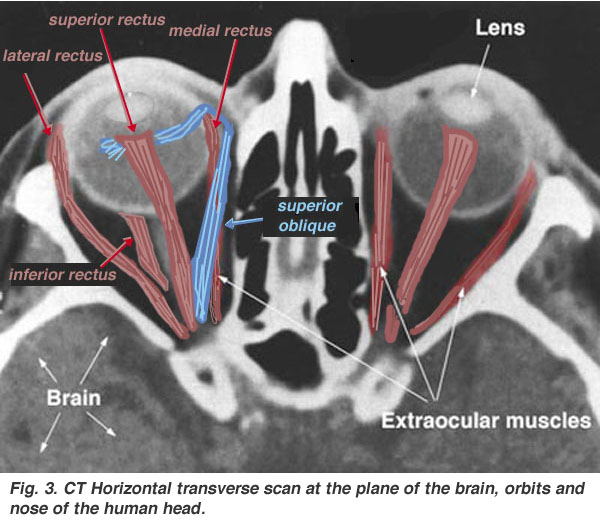
Ada enam otot mata yang berfungsi memegang sklera. Empat di antaranya disebut otot rektus (rektus inferior, rektus superior, rektus eksternal, dan rektus internal). Otot rektus berfungsi menggerakkan bola mata ke kanan, ke kiri, ke atas, dan ke bawah. Dua lainnya adalah otot obliq atas (superior) dan otot obliq bawah (inferior).

3. Fungsi Mata

Sinar yang masuk ke mata sebelum sampai di retina mengalami pembiasan lima kali yaitu waktu melalui konjungtiva, kornea, aqueus humor, lensa, dan vitreous humor. Pembiasan terbesar terjadi di kornea. Bagi mata normal, bayang-bayang benda akan jatuh pada bintik kuning, yaitu bagian yang paling peka terhadap sinar.

Ada dua macam sel reseptor pada retina, yaitu sel kerucut (sel konus) dan sel batang (sel basilus). Sel konus berisi pigmen lembayung dan sel batang berisi pigmen ungu. Kedua macam pigmen akan terurai bila terkena sinar, terutama pigmen ungu yang terdapat pada sel batang. Oleh karena itu, pigmen pada sel basilus berfungsi untuk situasi kurang terang, sedangkan pigmen dari sel konus berfungsi lebih pada suasana terang yaitu untuk membedakan warna, makin ke tengah maka jumlah sel batang makin berkurang sehingga di daerah bintik kuning hanya ada sel konus saja.

Pigmen ungu yang terdapat pada sel basilus disebut rodopsin, yaitu suatu senyawa protein dan vitamin A. Apabila terkena sinar, misalnya sinar matahari, maka rodopsin akan terurai menjadi protein dan vitamin A. Pembentukan kembali pigmen terjadi dalam keadaan gelap. Untuk pembentukan kembali memerlukan waktu yang disebut adaptasi gelap (disebut juga adaptasi rodopsin). Pada waktu adaptasi, mata sulit untuk melihat.

Pigmen lembayung dari sel konus merupakan senyawa iodopsin yang merupakan gabungan antara retinin dan opsin. Ada tiga macam sel konus, yaitu sel yang peka terhadap warna merah, hijau, dan biru. Dengan ketiga macam sel konus tersebut mata dapat menangkap spektrum warna. Kerusakan salah satu sel konus akan menyebabkan buta warna.

Jarak terdekat yang dapat dilihat dengan jelas disebut titik dekat (punctum proximum). Jarak terjauh saat benda tampak jelas tanpa kontraksi disebut titik jauh (punctum remotum). Jika kita sangat dekat dengan obyek maka cahaya yang masuk ke mata tampak seperti kerucut, sedangkan jika kita sangat jauh dari obyek, maka sudut kerucut cahaya yang masuk sangat kecil sehingga sinar tampak paralel. Lihat Gambar 11.18. Baik sinar dari obyek yang jauh maupun yang dekat harus direfraksikan (dibiaskan) untuk menghasilkan titik yang tajam pada retina agar obyek terlihat jelas. Pembiasan cahaya untuk menghasilkan penglihatan yang jelas disebut pemfokusan.

Cahaya dibiaskan jika melewati konjungtiva kornea. Cahaya dari obyek yang dekat membutuhkan lebih banyak pembiasan untuk pemfokusan dibandingkan obyek yang jauh. Mata mamalia mampu mengubah derajat pembiasan dengan cara mengubah bentuk lensa. Cahaya dari obyek yang jauh difokuskan oleh lensa tipis panjang, sedangkan cahaya dari obyek yang dekat difokuskan dengan lensa yang tebal dan pendek. Perubahan bentuk lensa ini akibat kerja otot siliari. Saat melihat dekat, otot siliari berkontraksi sehingga memendekkan apertura yang mengelilingi lensa. Sebagai akibatnya lensa menebal dan pendek. Saat melihat jauh, otot siliari relaksasi sehingga apertura yang mengelilingi lensa membesar dan tegangan ligamen suspensor bertambah. Sebagai akibatnya ligamen suspensor mendorong lensa sehingga lensa memanjang dan pipih. Proses pemfokusan obyek pada jarak yang berbeda-berda disebut daya akomodasi.

a. Akomodasi mata saat melihat jauh
b. Akomodasi mata saat melihat dekat

4. Kelainan pada Mata

Pada anak-anak, titik dekat mata bisa sangat pendek, kira-kira 9 cm untuk anak umur 11 tahun. Makin tua, jarak titik dekat makin panjang. Sekitar umur 40 tahun - 50 tahun terjadi perubahan yang menyolok, yaitu titik dekat mata sampai 50 cm, oleh karena itu memerlukan pertolongan kaca mata untuk membaca berupa kaca mata cembung (positif). Cacat mata seperti ini disebut presbiopi atau mata tua karena proses penuaan. Hal ini disebabkan karena elastisitas lensa berkurang. Penderita presbiopi dapat dibantu dengan lensa rangkap. Mata jauh dapat terjadi pada anak-anak; disebabkan bola mata terlalu pendek sehingga bayang-bayang jatuh di belakang retina. Cacat mata pada anak-anak seperti ini disebut hipermetropi.

Miopi atau mata dekat adalah cacat mata yang disebabkan oleh bola mata terlalu panjang sehingga bayang-bayang dari benda yang jaraknya jauh akan jatuh di depan retina. Pada mata dekat ini orang tidak dapat melihat benda yang jauh, mereka hanya dapat melihat benda yang jaraknya dekat. Untuk cacat seperti ini orang dapat ditolong dengan lensa cekung (negatif). Miopi biasa terjadi pada anak-anak.

Astigmatisma merupakan kelainan yang disebabkan bola mata atau permukaan lensa mata mempunyai kelengkungan yang tidak sama, sehingga fokusnya tidak sama, akibatnya bayang-bayang jatuh tidak pada tempat yang sama. Untuk menolong orang yang cacat seperti ini dibuat lensa silindris, yaitu yang mempunyai beberapa fokus.

Katarak adalah cacat mata, yaitu buramnya dan berkurang elastisitasnya lensa mata. Hal ini terjadi karena adanya pengapuran pada lensa. Pada orang yang terkena katarak pandangan menjadi kabur dan daya akomodasi berkurang.

Kelainan-kelainan mata yang lain adalah:

  • Imeralopi (rabun senja): pada senja hari penderita menjadi rabun
  • Xeroftalxni: kornea menjadi keying dan bersisik
  • Keratomealasi: kornea menjadi putih dan rusak.


Seputar Bulutangkis
bulutangkisindonesia.blogspot.com

03 April 2007

'Quiet Eye' Helps Elite Athletes

By Julie Clothier for CNN

(CNN) -- When you are at the top of your game in sport, it is difficult to make big improvements to your form.

But a scientist at the University of Calgary, Canada, is getting impressive results from testing and training players' vision, using eye-tracking and motion analysis technology to do so.

Professor Joan Vickers, a specialist in kinesiology --- the study of anatomy and body movement -- has been researching the role of gaze and attention in sport for more than 20 years.

She has been developing the "Quiet Eye" technique since the early 1980s, in an effort to understand how vision can control and guide the body's movements.

The technique is a measure of visual focus, recorded with a variety of technologies, which, according to Vickers, gives an athlete insight into their actions.

Vickers told CNN that the technique is beginning to "emerge as a potential predictor of elite athlete performance."

The "Quiet Eye" is based on key elements of data, which Vickers compiles during her research -- what the athlete sees and when, and for how long.

The first is the optimal location of the eyes' focus in space. For example, the best place on which to focus in golf is the back of the ball, while in basketball it is the front of the hoop.

"The precision of the quiet eye location often mirrors the precision required to perform well in a sport. In golf, precision of movement and precision of focus are paramount," says Vickers.

The second is the when the eyes begin to focus. The timing of focus is crucial, says Vickers, and varies depending on the sport.

The third is when the players' gaze leaves the "optimal location."

"In golf putting, for example, it has to stay on the back of the ball through the stroke and dwell for 200 or 300m on the green, after contact. Most golfers do not do this consistently," says Vickers.

The final quality is the duration of the quiet eye's period.

"It's about their ability to maintain a single focus even as all the motor activity is going on," she says.

"The top athletes that I work with have wonderful physical attributes but what some of them lack is visual focus and concentration," she says.

"Because this type of data has not existed in sport science before, it is new information that many find incredibly helpful -- most athletes don't have a motor problem. They have a concentration problem or a focus problem."

This, she says, can be fixed by first testing these things to see where improvement is needed, and then, once the weaknesses have been identified, train the players' attention system to perform better by controlling the gaze.

Technology has made Vickers' research easier, she says. Twenty years ago the technology to track eye movement did not allow the athlete to move.

Now lightweight eye trackers are small enough to be worn without affecting a player's performance.

Essentially an eye tracker monitors the movement of the eye and head -- in other words, the gaze -- as a unit.

It is able to locate the eye and see where the wearer is looking by monitoring the movement of the pupil.

The tracker records information using two miniature cameras and a mirror, which are hooked up to a computer.

As well as the eye tracker, Vickers uses external cameras to record what the body is doing. Eight or more cameras can be used at any one time to monitor the player.

Data based on the players' eye, gaze and motor movements are captured every 33.33 milliseconds per frame -- a time code generator synchronizes the eye image, the gaze image and the body image.

Vickers has used her technique to carry out quiet eye testing and training athletes in a wide range of sports, including golf, basketball, ice hockey, volleyball and rifle shooting, with impressive results.

When the university of Calgary's women's basketball team started using quiet eye training, the team's free throws scoring statistic improved in competition by 22 percent in two seasons and the team went from being ranked 17th in their league to second in Canada.

A university in the Netherlands is now also using the technique and finding the same kind of increases.

"Normally when you train athletes at the highest level you get a one or two percent improvement," says Vickers.

"What I like about it is that's it's all natural. It's about training your mind and your body at the same time in the settings that count. It has the potential of being extremely powerful."


Seputar Bulutangkis
bulutangkisindonesia.blogspot.com

Yoga Exercise - Eye Training


Like any other muscles, the eye muscles also need exercise to be healthy and strong. Most of the time, we only shift our gaze minimally from left to right, as when reading, and turn our heads if we want to look elsewhere. By moving the eyes in every direction, without turning your head at all, these Five Yoga Eye Exercises will strengthen the eye muscles, help prevent eyestrain and improve eyesight. Breathe normally while you practice.

First look up, then look down. Now look to the far right and then look far left. Next look up to the right, then look diagonally downward to the left. Repeat in the opposite direction. Now imagine a large clock - look up at 12 o'clock, then circle around it clockwise, quite slowly for two rounds then quicker for three. Repeat the exercise in a counterclockwise direction. Lastly, hold your thumb up about a foot from your face, and move your eyes from the thumb to the wall beyond and back. To end, always "palm" your eyes as shown below.

Rolling the Eyes


Eye Training - Rolling the Eyes 1. Look up; look down (x5).

2. Look far right; look far left (x5).

3. Look top right; look bottom left (x5); look top left; look bottom right (x5).

4. Look up, circle around clockwise (x5); anticlockwise (x5).

5. Look at the thumb, then wall, then back, near to far focusing (x5).


Palming


Eye Training - Palming Rub your palms together vigorously until they feel warm. Now cup your hands over your closed eyes, without pressing. The heat and the darkness will soothe and relax your eyes.


This article was contributed by: www.cyberastro.com and www.movingintostillness.com.


Seputar Bulutangkis
bulutangkisindonesia.blogspot.com

Can't See 3D

How to See 3-D -- It Takes Two Eyes to Tango!

In order to view 3D stereo images (in the Spy Kids 3-D movie, 3-D posters, pictures, books, etc.) you must have two eyes that work together as a coordinated team. Two working eyes are definitely required! Check your equipment before continuing.

Looking in the mirror to make sure you have two eyes and that they are both open is NOT an adequate inspection of your 3D viewing equipment. If you are having trouble seeing 3D, this might mean that you have problems with your binocular (two-eyed) vision or stereo vision (3D vision).

Consider testing your own binocular vision with The Framing Game and The Eye Hop Game for starters.

If you are having a really hard time seeing 3D movies, pictures, etc., have your vision checked by an optometrist who specifically tests binocular vision. You can locate a binocular specialist through Find a Doctor.

Even if it turns out that you do have a problem with your two-eyed vision, don't worry! severe visual disabilities which make seeing in 3D difficult or impossible. This group includes those who have lost an eye or only some of those with medical diagnoses of amblyopia (lazy eye) or strabismus (eye turns -- "crossed eyes" or "wandering eyes"). In MANY cases, two-eyed vision (binocular vision) can be improved with corrective lenses and/or vision therapy. Less than five percent of the population have

According to Dr. Jeffrey Cooper, ""It is often asked at what age should treatment no longer be attempted [for amblyopia or strabismus]. The answer is, everyone deserves a chance! Age should not be a deterrent to treatment."

If you're having problems seeing 3D, take the time to find out if a vision problem may be the cause. Binocular vision problems are more common than you might think. At least 12% of people have some type of problem with their binocular vision.

Why Stereo Vision?
Stereo vision is a normal part of human vision and you've got to have it in order to see 3D illusions and have normal depth perception. To learn more abut stereo vision, read Dr. Jeff Cooper's explanation of the Evolution of Two Eyed Vision at All About Strabismus.

Spy Kids 3-D Falls Flat for Kids with Eye Problem

Are you or your kid wondering what everyone is oohing and aahing about while watching the Spy Kids 3D movie? Does watching Spy Kids 3D seem confusing or give you headaches?

Learn what others are saying about Spy Kids 3D and vision problems by following the links below:

Zap 2It - Some Kids Just Don't Get "Spy Kids 3-D"

SciFi.com Some Kids Miss 3-D


Seputar Bulutangkis
bulutangkisindonesia.blogspot.com

How to See 3D


The Logical Approach to Seeing 3D Pictures
-- Understand Where to Aim Your Eyes --

please note that this page explains how to see 3D pictures without 3d glasses. This is called "free-viewing."

There are three basic ways of looking at 3D pictures with both eyes...


Normally, if you look at or read something on the computer monitor, you aim your eyes directly at the surface of the monitor. You may already have mastered this technique (have you had a lot of practice?!). If you use normal regular ol' viewing to look at 3D images in our 3D Art Gallery, nothing will pop out. You won't see 3D!


With the parallel viewing method (a.k.a. the divergence or Magic Eye method), the lines of sight of your eyes move outward toward parallel and meet in the distance at a point well behind and beyond the image. That's why it's called parallel viewing. When you parallel-view, the muscles inside your eye that control the focusing lens relax and lengthen.

NOTE: there are several parallel-viewing sections in the 3D gallery. All Magic Eye stereograms are set up for parallel-viewing.


Another method for 3D viewing is called cross-viewing or the cross-eyed method. You aim your eyes so that the lines of sight of your eyes cross in front of the image. When you cross-view, the muscles inside your eye that control the focusing lens contract strongly and shorten.

NOTE: The 3D Gallery has some sections designed specifically for cross-viewing. If you cross-view Magic Eye pictures or other images intended for parallel-viewing, shapes that should pop out will look punched in. For example, a Magic Eye stereogram that was designed to have a star popping out in 3D would look like it has a star-shaped hole cut into the background.

If you come across the old side-by-side stereo photograph cards (made to be viewed with a hand-held or table stereoscopes or stereo-opticon), you can use the cross-viewing method to free-view the images. However, this is for advanced free-viewers -- only Olympians of free-viewing need apply!


The Practical Approach to Seeing 3D
-- Try these Step-by-Step Methods --

  1. Parallel and Cross-Viewing: Using the Dots as "Training Wheels"
  2. Parallel-Viewing: Putting Your Nose Into It
  3. Parallel-Viewing: The Reflection Method
  4. Cross-Viewing: The Single Finger Method

The Ticket to Parallel-viewing
(A GUARANTEED TRICK!)


Seputar Bulutangkis
bulutangkisindonesia.blogspot.com


What is Stereovision

Two Eyes = Two Separate Views!

Human beings generally come equipped with two eyes and one head. Make sure you have these necessary parts before attempting to see 3D. If you have any doubts about your equipment or your ability to see 3D, check out Why Some People Have Trouble Seeing 3D before continuing.

Unlike horses, humans have two eyes located side-by-side in the front of their heads. Thanks to the close side-by-side positioning, each eye takes a view of the same area from a slightly different angle. The two eye views have plenty in common, but each eye picks up visual information the other doesn't. Have you ever compared the different views of your right and left eye? The Eye Hop Game lets you do just that.


Two Eyes = Three Dimensions (3D)!
Each eye captures its own view and the two separate images are sent on to the brain for processing. When the two images arrive simultaneously in the back of the brain, they are united into one picture. The mind combines the two images by matching up the similarities and adding in the small differences. The small differences between the two images add up to a big difference in the final picture! The combined image is more than the sum of its parts. It is a three-dimensional stereo picture.

The word "stereo" comes from the Greek word "stereos" which means firm or solid. With stereo vision you see an object as solid in three spatial dimensions--width, height and depth--or x, y and z. It is the added perception of the depth dimension that make stereo vision so rich and special.

Stereo Vision Has Many Advantages
Stereo vision--or stereoscopic vision --probably evolved as a means of survival. With stereo vision, we can see
WHERE objects are in relation to our own bodies with much greater precision--especially when those objects are moving toward or away from us in the depth dimension. We can see a little bit around solid objects without moving our heads and we can even perceive and measure "empty" space with our eyes and brains.

If You've Got Stereo Vision, Count Your Blessings!
According to the web site of the American Academy of Opthalmology, September, 1996: "many occupations are not open to people who have good vision in one eye only [that means people without stereo vision]"

Here are a few examples of occupations that depend heavily on stereo vision:

  • Baseball player
  • Waitress
  • Driver
  • Architect
  • Surgeon
  • Dentist

Here are just a few examples of general actions that depend heavily on stereo vision:

  • Throwing, catching or hitting a ball
  • Driving and parking a car
  • Planning and building a three-dimensional object
  • Threading a needle and sewing
  • Reaching out to shake someone's hand
  • Pouring into a container
  • Stepping off a curb or step

Are You Sure You've Got Stereo Vision?
It's hard to know what you're missing, if you've never had it. Do you see with both your eyes? Are your two eyes similar or different in sight?

This Is Just A Test -- of Your Stereo Vision System
Are both your eyes turned on and working together as a team? Try this easy test and find out if you are a good candidate for 3D viewing. It's The Framing Game and it only takes a minute!

* To read more about the difference between the side vision of horses and the frontal vision of humans, check out Dr. Cooper's really cool explanation about the evolution of two-eyed vision in carnivorous hunters (humans, lions, tigers, sharks, etc.).

You may have arrived at this page because you were searching for an explanation as to why you can't see Spy Kids 3D or The Adventures of Lava Girl and Shark Boy 3D. Can you see 3D? If you can't, keep reading and find out why?!!


Seputar Bulutangkis
bulutangkisindonesia.blogspot.com

Vision and Learning Disabilities


Eighty percent of everything a child learns is acquired through his or her visual system. According to the American Optometric Association, about sixteen percent of all children suffer from inadequate visual skills and up to ninety-four percent of children with reading problems have reduced visual skills.

If your child exhibits any of the following behaviors, he or she may be suffering from a problem with convergence and/or adequate visual function and/or visual perception. These visual problems can contribute to learning disabilities or, in some cases, can be mistaken or misdiagnosed as learning disabilities.

Your child . . .

  • Seems bright, but struggles with reading.
  • Fatigues quickly when reading, with frequent signs of frustration.
  • Is unable to sit still; cannot stay on task for any length of time.
  • Reverses words, numbers or letters.
  • Has difficulty remembering spelling words.
  • Is disorganized and frustrated when studying visual information.
  • Frequently loses his place, skips words or whole lines of text.
  • Has poor reading comprehension.
  • Has difficulty copying from the board or a book, has sloppy handwriting.
  • Medication or tutoring has not been successful in improving school performance.
  • Has been labeled LD (learning disabilities), ADD, ADHD, or dyslexic.

What is the treatment strategy when it is determined that a defect in visual function is present?

When indicated, a personalized and interactive vision therapy program can be administered under supervision. Each program is individualized to meet a child's specific visual needs. This type of therapy is short-term and goal-oriented.


Seputar Bulutangkis
bulutangkisindonesia.blogspot.com


VISUAL DEVELOPMENT


Parents' Guide to Children's Visual Development

Excerpted from: A Reference Guide for Preschool Children's Vision Development
© Optometric Extension Program, 1995

VISUAL DEVELOPMENT

More than 98 percent of all infants are born with normal, healthy seeing organs -- the eyes. Many authorities believe this high rate of normalcy occurs because the eyes and the entire visual system are so important to humans.

However, the normal health and structure of the eyes do not guarantee that your child will be able to use those eyes efficiently in the world he must see and interpret. The classroom, into which your child enters around the age of six, demands much of a child's vision. This classroom, and its special tasks, demands visual abilities and skills every child must learn before he enters school if he is to be successful there. These abilities and skills are learned much better by your preschool child when you (and all others caring for your child) know how to evaluate your child's progress, and how to guide and assist this vision development for future academic success.

This Parents' Guide is designed to give you enough information about visual development so you can make intelligent observations, and know when, where and how to help your preschool child. The Parents' Preschool Visual Development Checklist, which follows some General Notes below, can help you know where your child is on the scale of developing necessary visual skills. Because the sequence of child development is more important than the age at which a given skill developed, all ages given on the checklist are approximate. If your child lags behind the scale by more than four to six weeks in the time from birth to age two, professional help should be sought to assure your child's successful performance in his academic future. Referrals to eye doctors who specialize in children's visual development can be obtained through this site by visiting our Directory.

General Notes to Consider Before Going Through the Checklist:

APPEARANCE OF THE EYES

Most of the conditions noted will immediately catch your attention. However, none of these conditions should ever be allowed to continue. Children do not "outgrow" developmental delays or gaps. The basic physical condition of the eyes must be normal, and the eyes healthy, if your preschooler is to develop the visual skills necessary for achievement in the classroom.

If any one of these developmental activities is omitted, or practiced too briefly by your baby, it is important to watch all other developmental signs to be certain your baby is gaining all the skills he needs. Delay in visual development can interfere with total development because of the close interrelationships between all sensory systems (sensory motor integration).

SPECIAL NOTE: Parents frequently become alarmed when they see one of their child's eyes appearing to turn in (deviating) toward the child's nose. When the child is very young, and the bridge of the nose is still very flat and broad and this can give a false appearance of a crossed-eye (pseudostrabismus). Look carefully at pictures of your child, and if the reflections of the camera flash bulb are centered in the pupil (the black, round center of each eye), there is probably little cause for concern. However, if this reflection is not in the center of the eye, professional attention should be sought immediately because children seldom outgrow vision problems without professional assistance. Do not hesitate to get several opinions before anything as radical as eye muscle surgery is recommended for your child at these early ages. There are several proven clinical (non-surgical) procedures to alleviate most of these problems, and surgery should always be the last resort. To learn more about eye muscle surgery for eye deviations go to our information page.

For instructions on specific activities for observing your child's visual development, read through Important Observation Parents Can Make. The activities and observations explained on this page can help you make better use of the Parents' Preschool Visual Development Checklist.

dotted rule

Parents' Preschool Visual Development Checklist

© Optometric Extension Program, 1995

Dear Parent:

Your child's visual readiness for school starts developing on the day of birth. Every moment of visual experience is a part of the practice and organization which will prepare your child for the visual load of the classroom. This checklist has been prepared by developmental optometrists (behavioral optometrists) and informed educators to help you assure your child of the success and pleasure available in all the academic years that lie ahead.

1. APPEARANCE OF EYES:

  • Unusual redness of eyes
  • Unusual redness of lids
  • Crusted eyelids
  • Styes, or sores, on lids
  • Excessive tearing
  • Unusual lid droopiness
  • One eye turns in or out with fatigue

2. EVIDENCE OF DISCOMFORT

  • Excessive rubbing of eyes
  • Avoids bright light
  • Keeps eyes closed too much of the time

3. EXPECTED VISUAL PERFORMANCES:

Birth to 6 weeks of age:

  • Stares at surrounding when awake
  • Momentarily holds gaze on bright light or bright object
  • Blinks at camera flash
  • Eyes and head move together
  • One eye may seem turned in at times

8 weeks to 24 weeks:

  • Eyes begin to move more widely with less head movement
  • Eyes begin to follow moving objects or people (8-12 weeks)
  • Watches parent's face when being talked to (10-12 weeks)
  • Begins to watch own hands (12-16 weeks)
  • Eyes move in active inspection of surroundings (18-20 weeks)
  • While sitting, looks at hands, food, bottle (18-24 weeks)
  • Now looking for, and watching more distant objects (20-28 weeks)

30 weeks to 48 weeks:

  • May turn eyes inward while inspecting hands or toy (28-32 weeks)
  • Eyes more mobile and move with little head movement (30-36 weeks)
  • Watches activities around him for longer periods of time (30-36 weeks)
  • Looks for toys he drops (32-38 weeks)
  • Visually inspects toys he can hold (38-40 weeks)
  • Creeps after favorite toy when seen (40-44 weeks)
  • Sweeps eyes around room to see what's happening (44-48 weeks)
  • Visually responds to smiles and voice of others (40-48 weeks)
  • More and more visual inspection of objects and persons (46-52 weeks)

12 months to 18 months:

  • Now using both hands and visually steering hand activity (12-14 months)
  • Visually interested in simple pictures (14-16 months)
  • Often holds objects very close to eyes to inspect (14-18 months)
  • Points to objects or people using words "look" or "see" (14-18 months)
  • Looks for and identifies pictures in books (16-18 months)

24 months to 36 months:

  • Occasionally visually inspects without needing to touch (20-24 months)
  • Smiles, facial brightening when views favorite objects and people (20-24 months)
  • Likes to watch movement of wheels, egg beater, etc. (24-28 months)
  • Watches own hand while scribbling (26-30 months)
  • Visually explores and steers own walking and climbing (30-36 months)
  • Watches and imitates other children (30-36 months)
  • Can now begin to keep coloring on the paper (34-38 months)
  • "Reads" pictures in books (34-38 months)

40 months to 48 months:

  • Brings head and eyes close to page of book while inspecting (40-44 months)
  • Draws and names circle and cross on paper (40-44 months)
  • Can close eyes on request, and may be able to wink one eye (46-50 months)

4 years to 5 years:

  • Uses eyes and hands together well and in increasing skill
  • Moves and rolls eyes in an expressive way
  • Draws and names pictures
  • Colors within lines
  • Cuts and pastes quite well on simple pictures
  • Copies simple forms and some letters
  • Can place small objects in small openings
  • Passes all the tests described in Important Observation Parents Can Make
  • Visually alert and observant of surroundings
  • Tells about places, objects, or people seen elsewhere
  • Shows increasing visual interest in new objects and place

REMEMBER: All the age ranges given above are approximate. Lags of a week or so are not unusual, but any definite developmental delay or non-performance should be given every necessary attention. The performances listed above are important. All are preparatory to school readiness and are visual skills which are essential to lifetime activities.


Seputar Bulutangkis
bulutangkisindonesia.blogspot.com


A Parent's Checklist

Binocular vision impairments affect at least 12 out every 100 children.


Early detection and treatment is vital.

Consult the Parent's Checklist below and look for early signs of vision impairments such as amblyopia ("lazy eye"), strabismus (esotropia, esophoria, exotropia, "wandering-eye", "crossed-eyes", wall eyes", alternating esotropia, intermittent exotropia, exophoria), double vision, poor visual coordination, convergence insufficiency, accommodation problems (i.e., accommodative esotropia) and more.

PLEASE NOTE: The information contained herein is intended to be educational and is not intended in any way as a substitute for medical advice and care from qualified vision care providers -- the reader is advised to consult a vision care professional in matters relating to visual health and particularly with respect to any symptoms that may require diagnosis or medical attention -- See the Directory of Vision Care Providers.

A Parent's Checklist

Look for these signs and symptoms

If you check off several items on the following checklist, consider taking your child for a thorough vision examination that includes the testing of the following visual skills:

You observe the following behavior in your child:

  • one eye drifts or aims in a different direction than the other (look carefully -- this can be subtle). This is significant even if it only occurs when the child is tired or stressed.
  • turns or tilts head to see
  • head is frequently tilted to one side or one shoulder is noticeably higher
  • squinting or closing of one eye
  • excessive blinking or squinting
  • poor visual/motor skills (often called, "hand-eye coordination")
  • problems moving in space, frequently bumps into things or drops things

While reading or doing close work your child:

  • holds the book or object unusually close
  • closes one eye or covers eye with hand
  • twists or tilts head toward book or object so as to favor one eye
  • frequently loses place and fatigues easily
  • uses finger to read
  • rubs eyes during or after short periods of reading

Your child frequently complains of:

  • only being able to read for short periods of time
  • headaches or eyestrain
  • nausea or dizziness
  • motion sickness
  • DOUBLE VISION!

Say no more. If your child reports seeing double, please take your child for a binocular vision evaluation immediately. You are invited to request a free referral at the Directory of Vision Care Providers.

Catch Visual Problems Early!

Early detection of visual problems greatly increases the chances of successful rehabilitation. Children should be examined by an eye doctor during infancy and preschool years to detect potential problems with binocular vision. This is particularly important if any member of the family has had ambylopia or strabismus. Testing of binocular teaming skills should be a part of every child's comprehensive eye examination.

A second opinion is warranted when your eye doctor:

  • diagnoses ambylopia or strabismus, but offers only surgery and/or patching -- no mention is made of eye exercises or other supporting vision therapies
  • recommends surgery only for cosmetic purposes (to make the eye appear straight to others) and does not believe that your child can develop binocular vision
  • tells you that it is too late for either surgery and/or patching and that your child can not develop binocular vision.

In the above cases, parents are advised to consult an eye doctor who offers comprehensive functional eye examinations.supervised vision therapy to children, particularly a behavioral optometrist.


Seputar Bulutangkis
bulutangkisindonesia.blogspot.com


Vision Screening Questionnaire

For Parents, Coach and Teacher


Does Your Child Have a Vision Problem That Might Be Interfering With School Performance?

If your child is not working up to potential in school there is a strong possibility that a vision problem might be present. According to experts, almost 50% of children with learning difficulties have vision disorders. In most cases these problems can be successfully treated leading to improved learning and better grades.

You can determine whether your child might have a learning related vision problem by completing the following questionnaire.

Print Out the form below and then for each question, CIRCLE the appropriate answer.

1. My child has difficulty concentrating and paying attention.

1. never 2. sometimes 3. often
2. My child requires a lot of time to complete homework.

1. never 2. sometimes 3. often
3. My child complains of blurred vision, or double vision when reading.

1. never 2. sometimes 3. often
4. My child complains of eyestrain or headaches when reading.

1. never 2. sometimes 3. often
5. My child loses his/her place when reading or skips words or lines.

1. never 2. sometimes 3. often
6. My child has difficulty copying from the board.

1. never 2. sometimes 3. often
7. My child has difficulty with handwriting.

1. never 2. sometimes 3. often
8. My child reverses letters, numbers or confuses similar words.

1. never 2. sometimes 3. often
9. My child becomes tired or sleepy after short periods of time or his/her reading comprehension deteriorates with time.

1. never 2. sometimes 3. often
10. My child has struggled in school.

1. never 2. sometimes 3. often

For each question your child's score will be 1, 2, or 3.

Add up the total score for the ten questions and compare it to the guidelines below.


Score What That Score Means
10-12 Your child probably does not have a vision problem interfering with school performance.
13-18 Your child may have a vision problem interfering with school performance.
19-30 Your child almost certainly has a vision problem interfering with school performance.

If a child has a score greater than 12 it is strongly suggested that an evaluation be done testing those aspects of vision that might be contributing to learning difficulties. If a problem is detected, a Vision Therapy program may be recommended to eliminate the vision disorders.


Seputar Bulutangkis
bulutangkisindonesia.blogspot.com


Eye Exams


For Parents ! ! ! ! !

A child's comprehensive eye examination should include the testing of the following visual skills which are aspects of normal, healthy vision.

Acuity-Distance: visual acuity (sharpness, clearness) at 20 feet distance.

Acuity-Near: visual acuity for short distance (specifically, reading distance).

Focusing Skills: the ability of the eyes to maintain clear vision at varying distances.

Eye Tracking and Fixation Skills: the ability of the eyes to look at and accurately follow an object; this includes the ability to move the eyes across a sheet of paper while reading, etc.

Binocular fusion: the ability to use both eyes together at the same time.

Stereopis: binocular depth perception.

Convergence and Eye Teaming Skills: the ability of the eyes to aim, move and work as a coordinated team.

Hyperopia: a refractive condition that makes it difficult to focus, especially at near viewing distances.

Color Vision: the ability to differentiate colors.

Reversal Frequency: confusing letters or words (b, d; p, q: saw, was; etc.)

Visual Memory: the ability to store and retrieve visual information.

Visual Form Discrimination: the ability to determine if two shapes, colors, sizes, positions, or distances are the same or different.

Visual Motor Integration: the ability to combine visual input with other sensory input (hand and body movements, balance, hearing, etc.); the ability to transform images from a vertical to a horizontal plane (such as from the blackboard to the desk surface).

Some basic eye exams or vision screenings test only one of the above: Acuity-Distance (clarity of sight in the distance, 20/20 eyesight).

An eye exam that tests distance vision only is NOT an adequate evaluation of a child's visual development. The visual skills listed above contribute significantly to a child's success with reading and school achievement.

Seputar Bulutangkis
bulutangkisindonesia.blogspot.com

Dominat Eye Test


Dear badminton players,

Even though you use both eyes as you see the world everyday, everyone has a dominant eye - one that works harder than the other. To figure out which eye is dominant for you, try this simple test.

  1. Find something to use as a target on a wall about 10 feet away from you. You can use almost anything as an object to focus on.

  2. With both eyes open, stick out your arm with your elbow extended and your thumb up.

  3. Place your thumb so it appears to cover your target. Ideally, the focused object should be something that your thumb can cover.

  4. Now, close your left eye then your right eye while watching your target.

Your target will be visible beside your thumb through one eye and hidden by your thumb through the other eye.

The eye that sees the thumb covering the target is your dominant eye.

Download "dominant eye" test card


Seputar Bulutangkis
bulutangkisindonesia.blogspot.com

02 April 2007

Speed Freaks


by Tim Keown

ESPN The Magazine
http://espn.go.com/magazine/vol5no11freaks.html


Jason Kidd sees more. He sees more on the basketball court, on the freeway, in the movie theater. After he and his wife watch a movie, he routinely asks her if she noticed some subtleties in the film's background. She rarely does, even though she has learned to look for them. Reporters who have spent time with Kidd say he invariably finishes their sentences, slightly under his breath, as a prelude to his answer. In a practical sense, this mental acuity allows Kidd to make high-speed decisions in the open court, decisions that go far beyond the mundane choices of shoot-or-pass. His refined sensory awareness is not limited to the basketball court; it's part of who he is.

This is why Kidd performs physical feats that can't be practiced, or repeated, or sometimes even believed. It is why some witnesses say he threw a pass on Feb. 22 against the Knicks that came straight out of Area 51. After a steal in the Knicks forecourt, 70 feet from his own hoop, he saw Lucious Harris down court, breaking to the basket through a floor scattered with Knicks and Nets. This is where the story takes on some fourth-dimension quality, and where it becomes slightly unbelievable. With the window of opportunity opening and closing in roughly half a second, Kidd wound up and threw a 60-foot bowling-ball pass -- complete with an Earl Anthony follow-through -- in the direction of Harris. Witness reports vary, but the ball bounced at least three times and was thrown with enough backspin to avoid defenders and somehow curve back -- on the third or fourth bounce -- to hit Harris in stride for a layup.

Unbelievable? Nets coach Byron Scott, who played with Magic Johnson, says, “I could see his body language, and I’m looking at this ball saying, ‘I don’t believe this ball is going to curve right to where Lucious can catch it.’ I’m watching this thing come down and I’m shaking my head. I told Jason, ‘That was one of the greatest passes I’ve seen.’ ”

Kidd sees the game of basketball in large chunks, as a movie, instead of the slide show that others see. Kidd knows, for instance, that Nets teammate Richard Jefferson prefers soft looping lobs and Kenyon Martin prefers them harder and faster. At game speed, even when Martin or Jefferson is trailing a play, Kidd can simultaneously see the situation (the potential for the lob) and accommodate his teammate’s preference. This split-second awareness is why Kidd occupies a rarefied spot in the basketball world. It is why, in a basketball sense, Jason Kidd is a genius.

The basis for this genius comes down to one word: Speed. But not by its traditional definition. This isn’t stopwatch, 40-yard dash speed. It’s brain speed, or how fast the mind puts the body in motion. It is memory, pattern recognition and preparation all mixed together. Physical speed -- the kind we can see and compute -- is the manifestation of what goes on in the mind beforehand. Mental speed becomes physical when Gary Payton, the human premonition, disrupts a three-on-one fast break by overplaying a passing lane and coming up with a steal. Or when Andruw Jones, seemingly off before the crack of the bat, tracks down a liner to the gap. Or when Allen Iverson, arms and legs in arbitrary abandon, embarks on one of his fearless rages through the lane.

Every time you watch, astonished, and ask yourself how did he do that, be assured it starts inside the brain. The best of the best are the ones who do their sharpest thinking when there’s no time to think. Put simply, mind speed is what we’re seeing when we can’t believe our eyes.

Think of it this way: As you read this sentence, you recognize the individual words and comprehend their meaning simultaneously. You do not need to read the words once to identify them and then reread them to understand their meaning. Both cognitive processes occur at once.

The best athletes play their sport the same way, but in their case they’re merging the mental and physical. Take Kidd’s bowling-ball pass. “The thing that impressed me the most,” says Jim Spanarkel, a Nets broadcaster and former NBA player, “was that in a split-second, he had the ability to not only line up Harris down at the other end of the floor, but realize that the only way he could get the ball safely to him was to try a pass that I’ve never seen in 25, 30 years of watching basketball.”

This mind speed, immediate and confident, is the essence of athletic greatness. The best recognize patterns no one else sees, whether it’s Andre Agassi tracking the path of a 140 mph serve, Jeff Gordon weaving through the bumper-to-bumper grind of the Daytona 500, or Joe Sakic skating at full speed and backhanding a no-look pass to a teammate across the ice. These guys see order in chaos, the secret code embedded in a page of text. It’s what Kidd sees in the open floor, and what Barry Bonds sees from the batter’s box.

On Oct. 4 of last year, with the entire sports world watching as he went for homer No. 70, Bonds stepped up for his final at-bat of a three-game series in Houston. In his previous 14 plate appearances in the series, Bonds had been walked eight times and hit once. An Astros coach joked that the only way Bonds was going to get a pitch to hit was if it came from Houston’s “Secret Weapon.” That weapon was Wilfredo Rodriguez, a ballistic-armed kid up from Double-A. So the lefthanded Bonds would see nothing to hit, unless it was leaving the hand of a wild, over-amped lefty at 97 mph.

As if to add torment to frustration, there was Rodriguez trotting in from the bullpen. He threw his first warmup pitch in the dirt, and air-mailed another to the screen. Bonds stood impassively in the on-deck circle. Rodriguez, his heart no doubt racing at hummingbird speed, took a few deep breaths. When Bonds got into the box, he trained his eyes on Rodriguez’s release point, while also peripherally scanning for any tip-off movement (body leans, looks, small steps) from the middle infielders. In this case, there was little doubt that Rodriguez was going to come at him hard, and Bonds has developed a visualization technique to help him hit pitches that approach 100 mph. He envisions he is playing catch with the pitcher, using his bat as a glove. Catch the ball and off it goes.

The first pitch was outside for a ball. He swung through the second one, a 95 mph fastball. With the 1-1 pitch, Rodriguez threw another fastball, chest-high at 96, and Bonds cranked it 454 feet into the thick Houston night. The Astros pitched to him once in the series, and he was ready.

The record-tying home run wasn’t merely a memorable physical act; it was a product of years of intense research. Bonds’ approach in the batter’s box is similar to that of a scientist in a laboratory. As he begins the malicious twitching of his bat, he senses subtle movements from fielders, sometimes after the pitcher starts his windup. A shortstop who cheats to one side (it can be as minute as an upper-body lean) can signal whether the pitch will be hard or soft. Bonds is also the undisputed master at picking up repetition in pitch patterns. If a pitcher falls into the slightest routine with his pitch selection -- a first-pitch fastball with a runner on first, for example -- Bonds will recognize it and exploit it.

And remember, this all happens in a matter of milliseconds. A major league fastball, thrown at 90 mph, travels from the pitcher’s hand to the plate in approximately 400 milliseconds, or about as long as it takes you to sneeze. Someone as advanced as Bonds, whose bat speed is unparalleled, takes 190-300 milliseconds to decide whether to swing the bat and another 160 milliseconds to get the bat to the ball. As the numbers suggest, a significant amount of the work has to be done before the swing. When he hits, Bonds is not simply reacting to the speed and location of the pitch. He has, in effect, seen it before it’s thrown.

Mind speed provides the framework to explain the way Marshall Faulk runs with the football. It might look random, but Faulk bases his water-bug moves on a number of nearly instantaneous observations. Before the ball is snapped, his mind takes a series of snapshots of the defense -- starting with the defensive linemen, then the linebackers, then the defensive backs -- and plots his course accordingly. In an era of max speed, with 260-pound inside linebackers running 4.5 40s, knowing tendencies and spotting patterns can mean the difference between being the best offensive player in the game and being a second-stringer. “Some guys have tunnel vision, but Marshall sees everything,” says Rams running backs coach Bobby Jackson. “I think he sees not only the guys approaching him, but the guys to the side of him and the guys behind him.”

Consider this move Faulk performed late last season against Indianapolis: Breaking through the line of scrimmage on an off-tackle play, Faulk found himself behind Rams center Andy McCollum, who had just made contact with a Colts linebacker. McCollum and the linebacker separated, and at that moment, with barely a body’s width separating the linebacker and the center, Faulk split the gap between the two and gained another 10 yards. “He went through them like a dart,” Jackson says. “I’ve never seen anything like it.”

More than foot speed or strength or nerve, a move like this takes the kind of mind speed that blurs the line between thought and action. How much time did he have to see the separation, make the decision and split the difference? Probably less than a half-second. Faulk’s physical skills aren’t carrying him; he’s not the fastest or most punishing back on his own team, much less in the entire NFL. In fact, the growing Faulk legend might simply be a triumph of the imagination. Despite the barely organized chaos of an NFL running play, with 22 bodies in various stages of commotion, Faulk’s assumptions are uncannily accurate.

***

What Kidd, Bonds and Faulk know, on some level, is that we’re all too slow. Don’t take it as an insult; it’s a physiological fact. You’re too slow, but so is Kidd. Charles Woodson is too slow in his backpedal, and Mike Cameron is too slow getting a jump on a fly ball. Bonds’ bat? Too slow. Faulk’s feet? Too slow. Oscar De La Hoya’s hands? Too slow.

Laboratory tests of human reaction time prove it. It’s always agonizing to inject science into sports, but the scientific truth is this: We’re all wired a bit slower than we’d like. The time it takes to commit a quick action -- a punch, a first step, a head fake -- is roughly 100 milliseconds. The time it takes to counter the action -- to try to block the punch, for instance -- averages 200 milliseconds.

It was once proposed that Muhammad Ali’s greatness was due to his remarkable reaction time. The time it took for him to respond to a punch thrown his way averaged 150 milliseconds. Phenomenal, but still not fast enough. If George Foreman threw a big right hand in 100 milliseconds and Ali didn’t recognize it in advance, his 150-millisecond response time was worthless. It’s something we all know instinctively, and science proves it: Mental speed is not only preferable in sports, it’s essential. Physical gifts aren’t enough.

U. of Oregon psychology professor Steven Keele has conducted laboratory tests on reaction times, using both visual and auditory stimuli. His subjects were asked to touch a screen when a certain visual stimulus appeared, or to respond audibly when they heard a certain sound. His results lead him to say, “If an athlete is reacting only to what he sees or hears, he’s going to be too slow. Nobody would deny the importance of quickness in sports, but the quickest person in the world will be demolished every time if his cognitive skills aren’t good. It’s as simple as that.”

In professional sports, everyone is gifted physically. Among the gifted, there is a distinct separation between the 98% who are merely exceptional and the 2% who are truly great. Mind speed gets close to answering one of sports’ nagging questions: Why do athletes possessing similar physical gifts -- speed, strength, jumping ability -- vary so widely in performance? We say Jerry Rice works harder than anybody, but there are those who work as hard and possess greater physical skills -- size, speed, elusiveness -- who will never step onto an NFL field. Line up eight USBL point guards next to John Stockton. Even if you could remove the age factor, Stockton would most likely be among the slowest of the group. But put them on the court and Stockton would do things the others haven’t even considered. His mind simply works faster.

***

Willie Jorrin is the undefeated WBC super-bantamweight champion. In the weeks leading up to a fight, he lives an ascetic lifestyle, eating one meal a day to manage his weight, running as many as 12 miles a day, keeping a manic gym schedule. Moreover, he seems to relish the unique brand of torture that comes with the training. On a recent afternoon in his Sacramento gym, Jorrin worked out nonstop for 90 minutes -- shadow boxing, sparring, 15 continuous minutes with the jump rope, followed by a medieval selection of abdominal work.

But what makes Jorrin a champion isn’t his training regimen or his strength or his willingness to take a punch. What makes him a champion is his ability to see an opponent’s punches before they even start. Anybody with the proper inclination can train himself to be supremely fit and generally fearless. What separates Jorrin, though, is the speed at which his mind functions.

Jorrin, 31, is a remarkably elusive fighter, an expert at dodging and blocking punches. His 122-pound body and hands are jackrabbit quick, but his mind is faster. While most boxers look their opponent in the eyes, Jorrin’s gaze remains fixed on an imaginary X that crosses his opponent’s chest. Every punch starts there, he says, with a muscle twitch or flex that foreshadows each left jab or right cross. Like Bonds reading a pitcher, Jorrin’s observations are so elevated that he can focus strictly on this quirky trigger mechanism. Experience has allowed the rest of his game -- footwork, positioning, hand speed -- to work as if on autopilot. “I see whatever’s coming, doesn’t matter what it is,” Jorrin says. “Your chest doesn’t lie.”

On Sept. 9, 2000, in Manchester, England, Jorrin won the WBC title with a 12-round decision over Britain’s Michael Brodie. The fight turned in the late rounds, when Jorrin’s technique paid big dividends. One benefit of focusing on the chest is that it allows Jorrin, peripherally, to see and assess his opponent’s feet. Boxers are trained to be implacable. They don’t show pain, and the good ones are so accustomed to being battered that the consequences barely register on their faces. Their feet betray them, though, and when Brodie’s feet began to search for balance in the ninth round, Jorrin took over. He says, “If I had been watching his eyes, like most fighters, I never would have picked up on it.”

Timing and awareness are vital elements of mind speed. Charles Woodson can be beaten deep by a receiver, sprint to recover, and on a dead run dive with an arm outstretched to deflect a pass at the last possible millisecond. How? By reading the receiver’s eyes and hands, and even basing his dive in part on the growing amplification of the crowd.

The faster an athlete’s mind works, the slower the game appears. Players talk about being in The Zone, when everything slows and the baseball or the basket or the receiver seems huge and inviting. Oakland’s Eric Chavez is just starting to see the game slow as his mind picks up speed. In a recent game against Seattle, Chavez lined a two-out, two-strike single to left in the seventh inning off Seattle’s Arthur Rhodes, a hard throwing lefty who’s tough on lefthanded hitters. Chavez hit a hard slider on the outside corner, a tough pitch made tougher by Rhodes’ ability to throw a 95 mph fastball. “It wouldn’t have happened two years ago, or even last year,” says Chavez. “I wouldn’t have touched that pitch.” What’s changed? “I’m picking up everything faster,” he says.

Like reading words across a page, when Chavez sees a 95 mph fastball, he can identify it and respond simultaneously. There is a physical element to this -- refining the mechanics of his swing, for instance -- but most of it is mental. “Every year, the game seems slower to me,” he says. “When I was a rookie, the guy throwing 95 looked like he was throwing 100. Now 95 looks like 90. If I’m seeing it real well, it seems like 85.”

A’s rookie first baseman Carlos Pena sees Chavez’s development as a model for his own. “When I’m going poorly, I’d rather work on my mind than go to the batting cage,” Pena says. “What makes you sweat doesn’t always make you better.” Pena watches film to pick up pitch patterns and visualizes himself succeeding in various situations. He also does eye exercises to enhance vision and concentration.

What Chavez is doing -- and Pena is hoping to do -- is increasing the speed at which he recognizes pitches, shaving precious milliseconds off the hitting process. This is why a pitcher who can control four pitches is inherently more dangerous than one who controls just one or two, no matter how hard he throws. At the big league level, the mental advantage of increasing the number of patterns you force a hitter to read and recognize is greater than the pure physical factor of speed.

It’s why Greg Maddux consistently makes hitters look foolish with an 87 mph fastball, and why A’s closer Billy Koch, whose fastball routinely tops 100 mph, sometimes gets rocked even when he has his best stuff. A hitter spends more time attempting to identify Maddux’s pitches than he does reacting. In this way, Maddux’s 87 -- with the possibility of three other pitches roaming in the hitter’s mind -- can seem faster to the hitter than Koch’s 100. Oakland’s David Justice, a 14-year veteran, is an unapologetic fastball hitter. Matter-of-factly, he says, “If a guy can throw four pitches for strikes, more than likely he’s going to get me.”

The best of the best are those who possess the mind speed to complete one action while thinking of the next, and maybe the one after that. I remember watching Kidd at the Arena in Oakland when he was in the ninth grade, standing at the top of the key and threading a lefthanded bounce pass to a player cutting to the basket from the right baseline. It was a 20-foot bounce pass, through several bodies, delivered with the timing and precision of a trained sniper. He gave no indication he was aware of being the youngest player on the court, in a state final, in a sold-out NBA arena. Even then, as a 15-year-old, his mind was the fastest on the floor.

Mind speed resists concrete definition, but we know it when we see it realized in physical form. For the fastest athletes, competition is close to an out-of-body experience; in their minds, what they’re doing is already done. “You try to stay at least one step ahead, if not two,” Kidd says.

This concept is often associated with words like “instinct,” “feel” or “knack.” It’s Jorrin seeing the punches before they become punches, and Faulk seeing holes that exist only for him. It’s how Derek Jeter can stray 150 feet from his customary position to track down an errant throw from right field and somehow backhand it to the plate to save a playoff game. Speed, as it is employed by the elite, carries an element of the extrasensory. We’re all too slow, but the best of the best have figured out how to compensate for nature’s deficiencies.

They’ve learned how to cheat science.

This article appears in the May 27 issue of ESPN The Magazine.


Seputar Bulutangkis
bulutangkisindonesia.blogspot.com


Sports Vision Training

An expert guide to improving performance by training the eyes.

by
Brian Ariel
http://www.pponline.co.uk/encyc/0148.htm

VERGENCE (also known as Fusion Flexibility) is the ability to rapidly and accurately fuse the two images from the eyes into one image when focussing from far to near (convergence) and vice-versa (divergence). The eyes work as a team to maintain this 'oneness' in all directions of gaze. Deficits in this ability, a slowness or a slackness in locking on to an object, can lead to double vision and poor timing. An example of vergence where speed is not essential is of a golfer looking at the ball and then at the hole on the putting green and repeating this procedure several times before hitting the ball. Speed of vergence is necessary in ice hockey where a player has to 'lock on' to a fast-moving puck.

Prism Flippers

This device is like two fronts of a pair of spectacles holding prismatic lenses. One set tends to pull the eyes in and the other pair tends to do the opposite. The training occurs when the subject makes an effort to overcome the deliberate double vision that the prisms cause. The number of times (flips) the subject sees singly when alternate pairs of lenses are put before his eyes in a given period is recorded. Practice increases this speed of vergence. A drawback to this method is that the subject , in order to impress the sports vision trainer (SVT), may not be completely honest. If a sportsperson has only one functioning eye or has a certain type of squint (strabismus), then eye teaming cannot occur and vergence difficulties cannot exist. There are sports when being monocular (one-eyed) has definite advantages.

ACCOMMODATION (also known as Focus Flexibility) is the ability to change focus from near to far or vice-versa. At rest, the eye is focussed at one metre so that focussing both nearer and further than one metre involves an accommodative effort. In most sports it is preferable to be able to focus clearly and quickly on the object of regard. It can be a moving object like a football or a stationary object like the fore and rear sights of a rifle while shooting. Orienteers, who have to read a map while running, need good speeds of accommodation. Deficits in this ability can lead to difficulty in timing and accuracy.

Plus/Minus Lens Flippers

These are similar in construction to the prism flippers described above. To measure this parameter of vision, the subject is instructed to focus on a suitable line of letters at an appropriate distance through lenses (low magnifying lenses) which force the eyes to relax their accommodation, and then through the other set of lenses (low minifying lenses) which do the opposite, forcing a contraction of accommodation. The number of times (or flips) clarity is achieved in a given period is recorded. The disadvantage of this method is the same as that described for vergence measurement.

Bart Charts

These are two identical letter and number charts. One is of reduced size to be used at a closer distance. They are aligned to simulate the sporting situation and the subject has to call out alternative letters or numbers, quickly focussing from one chart to the other. Each effort is timed and recorded to check progress. The SVT watches the subject's eyes to ensure that the subject doesn't re-focus and isn't just remembering a digit in advance from the easier chart.

A lot of the parameters just discussed are inextricably linked, especially accommodation and vergence and, to a lesser extent, spatial location (discussed last month).

SPEED OF RECOGNITION (also known as Visual Search) is the ability to recognise and abstract relevant information at a glance. A study of badminton players demonstrated that the better players could, even with limited visual clues, predict the position of the shuttlecock. They did this by making better and quicker use of the limited clues to extract relevant information only. When recreational players were given the same visual clues, they could not predict the shot. In fact, even with added clues they could not predict as well as the elite players. The novices were poor at recognising the essential information, and spent too much time scanning redundant information.

The Tachistoscope

This instrument is a manual projector with variable shutter speeds. It is used with slides of letters, numbers and sporting situations. To train speed of recognition, the shutter speed is increased in increments, from 1/10th to 1/100th second, while the subject tries to maintain the same level of search information as at the lower speeds. The SVT instructs the subject as to the information required before each slide is projected on to the screen. This might be to recall an array of numbers or to predict the trajectory of a ball. Practising this skill increases the speed and span of recognition.

VISUAL MEMORY is the facility to remember visual information, often at a glance. There are several examples in sport where this facility is highly beneficial - for instance:
motor sport: memorising the circuit with all its contours and bends helps in avoiding accidents;
snooker: as the cue ball is addressed, the elite player has a complete picture in his head of all the balls in play. This will not only allow him to place the cue ball in a good position for his next shot but also reduce the likelihood of leaving his opponent any advantage;
cricket: the batsman should have the field placings in his memory, so that he doesn't hit the ball to the fielders.

Wayne Saccadic Fixator

The programme used on this instrument (which was described last time) to train and measure this parameter is similar to the Simon Game played by children. To begin the test, a light on the panel comes on, and when the subject touches it, it goes off. Next, the same light comes on again plus, a second later, another light. This time the lights have to be extinguished in the same order that they appeared. After each successful attempt, which is displayed numerically, another light is added to increase the memory span. Failure to follow the correct sequence is indicated by an auditory signal. The delay in time between successive lights can be increased to add difficulty. By concentrating, the memory span can be seen to expand.

OCULAR DOMINANCE. A dominant or referential eye is the one which is sighted towards a target. It does not have to be the eye with the better vision, nor does it have to be allied to the dominant hand or foot. Sometimes there is no definite dominance, a condition which is often seen among dyslexics, and this can result in visual problems.

It is unwise to change a person's ocular dominance, although certain occasions may necessitate this rather drastic action. The dominant eye for distance vision (six metres upwards) may not be the same eye for intermediate or near vision (2/3 metre). If no definite dominance exists, then blurring or occluding one eye is of help.

There are a few ways to find out which eye is the dominant one:

  1. Ask the subject to make a small triangle using just the thumbs and forefingers of both hands, right on top of left, and then stretch the arms fully in front of his face while lining up to one of the observer's eyes. It is easy for the observer to see which eye the subject is using preferentially. This procedure should then be repeated twice more, and then another three times with the left hand on top of the right.
  2. Ask the subject to look through a tube at the observer. The subject will instinctively look through the tube with the dominant eye. Repeat the exercise half a dozen times.
  3. Ask the subject o stretch his arm straight ahead and point his finger at a small object. Then instruct him to close one eye and ask whether is finger is in line with the object. Repeat this exercise when closing the other eye. Looking with the non-dominant eye will result in a marked non-alignment. Once again, there should be a half a dozen attempts. It is most instructive to repeat the same routine at intermediate and near distances.
Cross dominance (or cross laterality) is where there is a right eye/left hand or left foot dominance or vice-versa. In sports where a side-on stance is required, his condition has definite advantages - for instance, batting in cricket. In a study of PGA players, measurements were made of the golfers' driving distances, and those who were cross dominant were also the longest hitters. If cross-dominant clay-pigeon shooters sight with their dominant eye, then there will be a mis-alignment in spotting the target. Partially blurring the offending dominant eye will aid accuracy.

Failing to have a dominant eye at a certain distance can cause inaccuracy in golf. A good example is a scratch golfer whose long and short putting were fine but at about eight feet he was constantly wayward. He had his dominance checked and at eight feet there was none. Instructing him to use only one eye solved the problem.

Contrary to popular belief, it is only when addressing a stationary ball that one has to keep one's eye on it all the time (it is impossible to track a fast-moving ball continuously). If a golfer is asked to close his dominant eye while swinging his club, he may well not be able to see the ball. However, if his stance is altered, even slightly, it may ensure that his dominant eye is definitely kept on the ball with the result that he will be able to hit further and more accurately.


Seputar Bulutangkis
bulutangkisindonesia.blogspot.com

“ATHLETES FIRST, WINNING SECOND”